
12 Powerful ChatGPT Modules: Ultimate Guide for Beginners
Just Now
9.5 MB
V4.6
Andriod +
1200K+
Description
Generative AI represents a subset of artificial intelligence designed to create new content—ranging from human-like text and code to images and music—by learning patterns from massive training datasets. Unlike traditional software that operates strictly on rigid rulebooks, generative models predict, synthesize, and compose original outputs based on probabilistic patterns. This shift has redefined human-computer interaction, enabling tools to draft documents, solve complex technical problems, and generate creative media in seconds.
ChatGPT, developed by OpenAI, stands as one of the most prominent consumer applications of this technology. Built on state-of-the-art neural networks, it acts as a conversational interface that can adapt to diverse domains, roles, and formatting requests on demand. By bridging natural human language with advanced computational capabilities, ChatGPT provides an accessible platform for brainstorming, task automation, learning, and productivity across virtually every industry.
ChatGPT is one of the most popular AI tools for writing, learning, and productivity. If you want to explore more useful applications, check out our guide to Best AI Apps and discover other powerful AI Tools that can make everyday tasks easier.
What is ChatGPT? (Core Concepts & Overview)
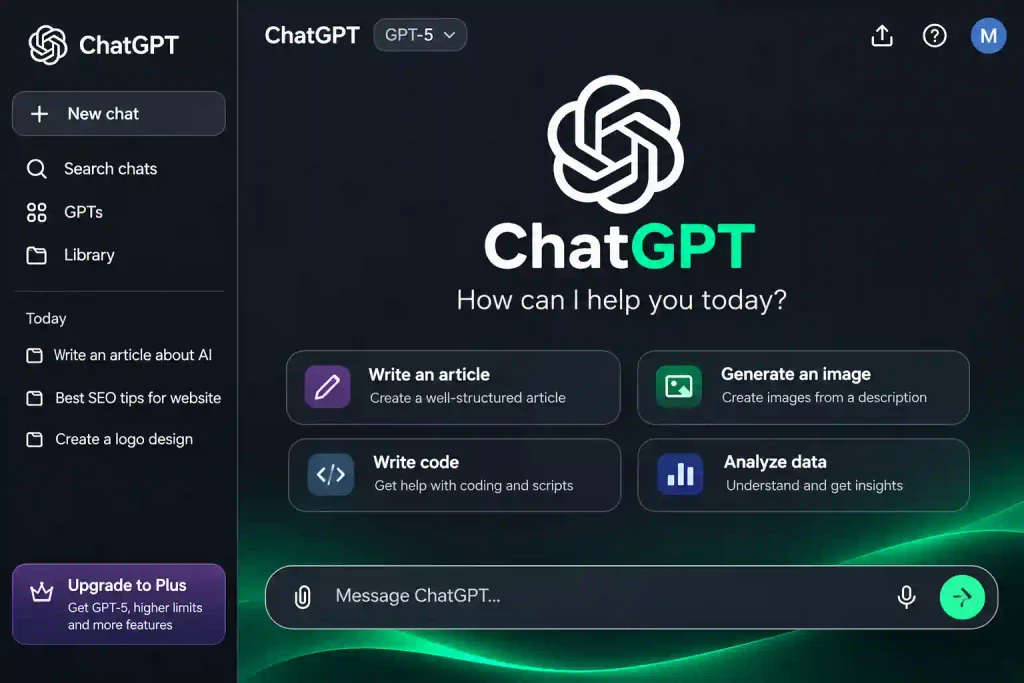
ChatGPT is an AI-powered conversational platform designed to process, interpret, and generate human language in real time. Powered by OpenAI’s Large Language Models, it operates by analyzing the text you input—known as a prompt—and predicting the most logically coherent, contextually accurate response. Beyond simple Q&A, it functions as a flexible assistant capable of summarizing lengthy documents, writing code, translating languages, and simulating complex scenarios, making high-level artificial intelligence directly accessible through a plain text chat interface. You can visit the website Apkmoz
Pros & Advantages of ChatGPT (Speed, Productivity & Capabilities)
| Core Advantage | Description & Business Impact |
|---|---|
| Instant Draft Generation | Accelerates writing tasks by creating initial drafts for emails, reports, and code in seconds. |
| 24/7 Availability | Functions as a tireless, round-the-clock assistant for research, brainstorming, and customer query resolution. |
| Multilingual Support | Translates and converts text across dozens of languages seamlessly, breaking down international communication barriers. |
| Adaptive Persona & Tone | Adjusts output style dynamically to match specific target audiences, technical levels, or creative requirements. |
| Rapid Problem Solving | Debugs broken code, analyzes logic flow, and provides step-by-step explanations for technical queries. |
| Task Automation | Automates repetitive administrative functions, content summarization, and initial document structuring. |
Cons, Limitations & Risks (Hallucinations, Privacy & Ethics)
- Risk of Hallucinations: Generates plausible-sounding but completely incorrect facts, figures, or references without self-awareness.
- Data Privacy Concerns: User inputs may be logged or used to train future model iterations unless explicitly opted out.
- Lack of Real-World Reasoning: Operates purely on text pattern recognition without true comprehension or emotional intelligence.
- Knowledge Cutoffs: Offline base knowledge can leave the model unaware of very recent real-world events or updates.
- Potential Bias: Reflects data biases present in its original internet training sets, requiring human review for fairness.
- Over-Reliance Hazard: Can lead to skill atrophy or uncached errors if users blindly copy outputs without verification.
- Security & Misuse: Risks of jailbreaking, phishing automation, or leaking confidential company IP in prompts.
Architecture, Models & How LLMs Work
- ChatGPT Transformer Foundation: Built on the Transformer neural network architecture, utilizing self-attention mechanisms to process text contextually.
- Next-Token Prediction: Functions fundamentally by calculating probabilities to predict the most likely next word or token in a sequence.
- Massive Pre-Training: Trained on vast datasets of web text, books, code, and articles to learn language structures.
- RLHF Fine-Tuning: Refined using Reinforcement Learning from Human Feedback to align outputs with safety standards and human intent.
- GPT Model Families: Features different model iterations (such as GPT-4o) optimized for speed, reasoning depth, or efficiency.
- Context Windows: Utilizes memory limits measured in tokens to track conversation history within an active session.
- Deterministic Parameters: Uses settings like “temperature” to control how creative or predictably focused its outputs are.
Account Setup, Subscriptions & Navigation
- Account Creation: Simple registration via standard email credentials, Google, Apple, or Microsoft single sign-on.
- Free vs. Paid Tiers: Free plans provide base access, while Plus/Team subscriptions unlock premium models, speed, and advanced tools.
- Interface Overview: Features a sidebar for chat history management and a main workspace for active prompting.
- Settings & Controls: Includes toggles for dark mode, voice settings, custom instructions, and conversation archiving.
- Data & Privacy Management: Allows users to control data sharing, delete chat history, or export complete account records.
- Mobile & Desktop Apps: Syncs chat history seamlessly across official iOS, Android, and desktop applications.
- Enterprise Workspace: Offers admin controls, central billing, workspace sharing, and enterprise-grade data security.
Fundamentals of Prompt Engineering
- ChatGPT Role Assignment: Specify a persona (e.g., “Act as a senior software developer”) to contextualize the output perspective.
- Clear Task Statements: State the requested action directly using strong action verbs like summarize, draft, or analyze.
- Context Provision: Supply background information and relevant data to reduce assumptions and keep responses accurate.
- Constraint Setting: Establish explicit boundaries, such as negative constraints (“Do not use jargon”) or word limits.
- Output Formatting: Request exact structures like Markdown tables, bulleted lists, JSON objects, or executive briefs.
- Few-Shot Examples: Provide input-output pairs directly in the prompt to show the AI the exact structure you expect.
- Iterative Refinement: Follow up with corrections and targeted tweaks rather than discarding the initial response.
Advanced Prompting Techniques & Frameworks
- ChatGPT Chain-of-Thought (CoT): Instruct the model to “think step-by-step” before giving a final answer to improve logical accuracy.
- Tree-of-Thoughts (ToT): Direct the model to evaluate multiple distinct reasoning paths or strategies before selecting the best one.
- ChatGPT Role-Task-Format (RTF): Use standardized structural frameworks to consistently craft comprehensive system prompts.
- Delimiters & Anchoring: Use triple quotes, XML tags, or markdown blocks to cleanly separate instructions from raw source data.
- Self-Consistency Prompting: Ask the model to generate multiple solutions independently and synthesize the common consensus.
- ChatGPT System-Level Context: Embed permanent guardrails and baseline guidelines inside system settings or Custom Instructions.
- Recursive Prompting: Break massive, complex workflows into a chain of smaller, sequential chat prompts for better precision.
Multimodal Features (Vision, Voice & Audio)
- ChatGPT Handbook Image Recognition: Upload diagrams, handwritten notes, or photos for instant visual analysis and textual extraction.
- Real-Time Voice Chat: Engage in natural, bidirectional spoken conversations with low latency on desktop and mobile apps.
- OCR Text Extraction: Convert image text, scannable forms, and whiteboard snapshots directly into clean editable text.
- Audio Processing: Analyze spoken context, tone, and speech patterns to power seamless voice interactions.
- Visual Troubleshooting: Upload photos of broken hardware, error screens, or physical items to get real-time repair advice.
- Multimodal Input Pairing: Combine image uploads with precise text prompts for targeted visual editing or explanations.
- Accessibility Enhancements: Allows visually impaired users to describe physical environments and read printed materials via camera.
Image Generation with DALL-E
- ChatGPT Handbook Natural Language Generation: Create detailed digital artwork, illustrations, and photorealistic images using standard text prompts.
- Prompt Refinement: ChatGPT automatically enhances basic text requests into optimized, detailed prompts for the DALL-E engine.
- Style Manipulation: Specify exact artistic styles, such as oil painting, isometric 3D render, watercolor, or vector graphic.
- Aspect Ratio Controls: Custom-fit generated images to wide landscape, vertical portrait, or square formatting specifications.
- In-Image Text Rendering: Place legible typography, signs, and labels directly into generated visual outputs.
- In-Painting & Editing: Highlight specific regions of an existing image to modify, remove, or replace elements iteratively.
- Consistent Character Creation: Maintain recognizable subjects and cohesive visual themes across sequential prompt outputs.
Data Analysis, Code Execution & File Handling
- Integrated Python Sandbox: Executes Python code in a secure environment to run calculations and analyze data live.
- File Processing: Upload CSVs, Excel spreadsheets, PDFs, and text files directly into the conversation for instant analysis.
- Data Visualization: Generates charts, line graphs, heatmaps, and scatter plots directly within the chat workspace.
- Automated Data Cleaning: Identifies missing values, strips duplicate rows, and reformats messy datasets systematically.
- Document Summarization: Summarizes multi-page reports, PDFs, and legal contracts in seconds.
- File Transformations: Converts file formats effortlessly—such as converting structured text tables directly into CSV files.
- Mathematical Modeling: Performs complex statistical calculations, trend forecasts, and financial modeling accurately.
Building & Customizing Custom GPTs
- ChatGPT Handbook No-Code Development: Create custom, specialized versions of ChatGPT using a conversational builder interface.
- Custom Knowledge Uploads: Attach custom PDFs, documentation, and company guidelines to expand your GPT’s domain expertise.
- Tailored Instructions: Configure persistent system prompts to dictate the exact behavior, tone, and rules of your GPT.
- Custom Capabilities: Toggle specific features on or off, including Web Search, DALL-E image generation, and Code Interpreter.
- API Actions: Connect custom GPTs to external databases, webhooks, and third-party software using OpenAPI schemas.
- Sharing & GPT Store: Publish custom tools publicly to the GPT Store, share them via private links, or keep them personal.
- Workspace Deployment: Deploy specialized GPTs across teams to standardize internal business workflows and operations.
Real-World Use Cases & Workflow Automation
- Content Strategy & Copywriting: Produce SEO articles, social media captions, marketing emails, and ad copy efficiently.
- Software Development: Generate starter code, write unit tests, refactor legacy scripts, and convert languages instantly.
- Customer Support: Build automated response workflows and standard operating procedure guides for support teams.
- Executive Assistant Tasks: Draft professional correspondence, organize weekly agendas, and distill long email threads.
- Research & Synthesis: Conduct market research, evaluate competitor offerings, and synthesize dense technical papers.
- Language Learning & Translation: Practice foreign languages through conversational roleplay and instant grammar feedback.
- Personalized Coaching: Build customized fitness routines, meal plans, study schedules, and step-by-step career roadmaps.
Conclusion
ChatGPT marks a fundamental shift in how humans interact with technology, moving software usage from rigid manual commands to fluid conversational collaboration. By mastering prompt engineering, leveraging multimodal capabilities, and understanding both the strengths and limits of Large Language Models, users can dramatically boost productivity across creative, technical, and analytical domains. As generative AI continues to evolve, using these tools responsibly and critically will remain essential to unlocking their full potential while maintaining data privacy and output accuracy.